Part 27 of the HikeLab Ultimate Ultralight Guide Series.
Ultralight backpacking and Leave No Trace should fit together naturally. Carrying less can reduce your impact, but going lighter does not automatically make a trip low-impact. In practice, minimalist hiking only aligns with Leave No Trace when you make deliberate choices about where you camp, how you manage waste, how you cook, and how you move through fragile terrain.
For ultralight backpackers, the goal is simple: cut pack weight without cutting environmental responsibility. That means using lighter systems to make better decisions, not using “minimalism” as an excuse to skip essentials, ignore regulations, or leave damage behind.
Key Takeaways
- Ultralight backpacking supports Leave No Trace when reduced gear helps you travel more carefully, camp more selectively, and avoid unnecessary disturbance.
- Going lighter can create new risks, especially around shelter choice, cold-weather prep, sanitation, and durability.
- The 7 Leave No Trace principles still apply fully to minimalist hikers; they just show up in different ways.
- The biggest ultralight mistakes are usually not dramatic. They are repeated small shortcuts: camping too close to water, poor cathole technique, using fragile social trails, and overrelying on fires.
- The best low-impact ultralight kit is not the absolute lightest setup. It is the lightest setup that still lets you follow regulations, handle weather, and avoid damaging the place.
Why Leave No Trace Matters Even More for Ultralight Hikers
Ultralight hikers often move farther, cover more ground in a day, and use smaller, simpler systems. That can be good for the landscape. Less gear often means less campsite sprawl, less fuel use in transport, fewer redundant items, and less temptation to build comfort features in camp.
But ultralight style also creates specific temptations:
- Choosing marginal campsites because a tiny shelter can fit there
- Skipping a trowel or sanitation kit to save ounces
- Depending on a campfire because you left warmer gear at home
- Wearing minimal footwear that encourages shortcutting through mud or vegetation
- Pushing mileage until you are too tired to make careful decisions
The real standard is not whether your pack is light. The standard is whether your choices leave the area essentially unchanged for the next person and for the ecosystem itself.
Leave No Trace and Ultralight Backpacking at a Glance
| Principle | Common Ultralight Advantage | Common Ultralight Risk | Best Practice |
|---|---|---|---|
| Plan ahead and prepare | Simpler kit encourages intentional packing | Underpacking critical items | Go light only after covering weather, regs, water, and waste |
| Travel and camp on durable surfaces | Smaller footprint, faster movement | Squeezing into fragile micro-sites | Use established sites or durable ground only |
| Dispose of waste properly | Smaller kit can mean less packaging | Skipping waste tools or sloppy hygiene | Carry a real poop kit and pack out trash fully |
| Leave what you find | Less interest in camp luxury | Overusing natural materials for comfort | Do not alter sites or collect “just a little” |
| Minimize campfire impacts | Many UL hikers already use stoves | Using fires to compensate for a thin kit | Treat fires as optional and often unnecessary |
| Respect wildlife | Quieter travel, smaller camps | Poor food storage to save weight | Match food protection to local animal pressure and regulations |
| Be considerate of others | Smaller camps can blend in | High-mileage groups can dominate shared space | Camp discreetly, keep noise down, yield well |
1. Plan Ahead and Prepare Without Underpacking
This is the first Leave No Trace principle for a reason. Most backcountry impact starts before the hike: bad route planning, poor weather prep, unrealistic mileage goals, and missing critical gear.
For ultralight backpackers, “plan ahead” means resisting the urge to strip your kit below what the trip actually requires.
What this looks like in practice
- Check local regulations on campsites, fires, food storage, dogs, permits, and human waste.
- Know whether the area requires a bear canister, wag bags, or camping in designated zones.
- Plan water carries realistically so you do not camp illegally near water out of desperation.
- Match insulation and shelter to actual forecast lows, wind, and exposure.
- Repackage food to reduce trash, but label critical items and avoid spills.
Decision criteria for ultralight planning
Choose the lightest setup that still allows you to:
- Stay warm without needing a fire
- Sleep on durable legal campsites
- Store food properly
- Manage human waste correctly
- Handle a delayed exit or weather shift
Common mistake to avoid
Do not confuse “I can survive with this” with “this is an appropriate backcountry system.” A kit that forces bad decisions is not truly ultralight. It is just incomplete.
2. Travel and Camp on Durable Surfaces, Not Tiny Fragile Spots
A small tarp or compact bivy can fit almost anywhere. That does not mean you should camp anywhere.
This is one of the biggest low-impact challenges for minimalist hikers. Because your shelter footprint is small, it becomes easy to justify marginal sites: a flat patch of alpine vegetation, a sandy river edge, a meadow corner, a cryptobiotic soil patch, or a hidden spot just off trail that nobody “will notice.”
People notice. More importantly, the land notices.
Best practice for ultralight campsite selection
Camp on:
- Established campsites where use is concentrated
- Durable bare ground
- Rock, gravel, dry grass where allowed and resilient
- Snow when conditions and skill allow
Avoid camping on:
- Fragile alpine tundra
- Wet meadows
- Riverbanks and lake edges
- Biocrust or desert crusts
- Fresh vegetation just because your shelter fits
Tradeoff: stealth vs impact
Minimalist hikers sometimes value hidden camps. In some settings, low-visibility camping reduces crowding and noise. But hidden is not automatically low-impact.
If an established site exists and local guidance supports using it, concentrating impact there is usually better than creating a new micro-site. The exception is when regulations or local best practice call for true dispersal on already durable surfaces.
Campsite mistake to avoid
Do not widen a site by clearing rocks, moving logs, trimming branches, or flattening plants to fit your tarp pitch. If the site does not work naturally, it is the wrong site.
3. Dispose of Waste Properly, Even if the System Adds Ounces
This is where a lot of “ultralight” ethics fall apart. Saving an ounce by skipping a trowel or carrying too little toilet paper is not worth it if your sanitation gets sloppy.
Minimalist hiking does not change the basics. You still need a complete human waste plan.
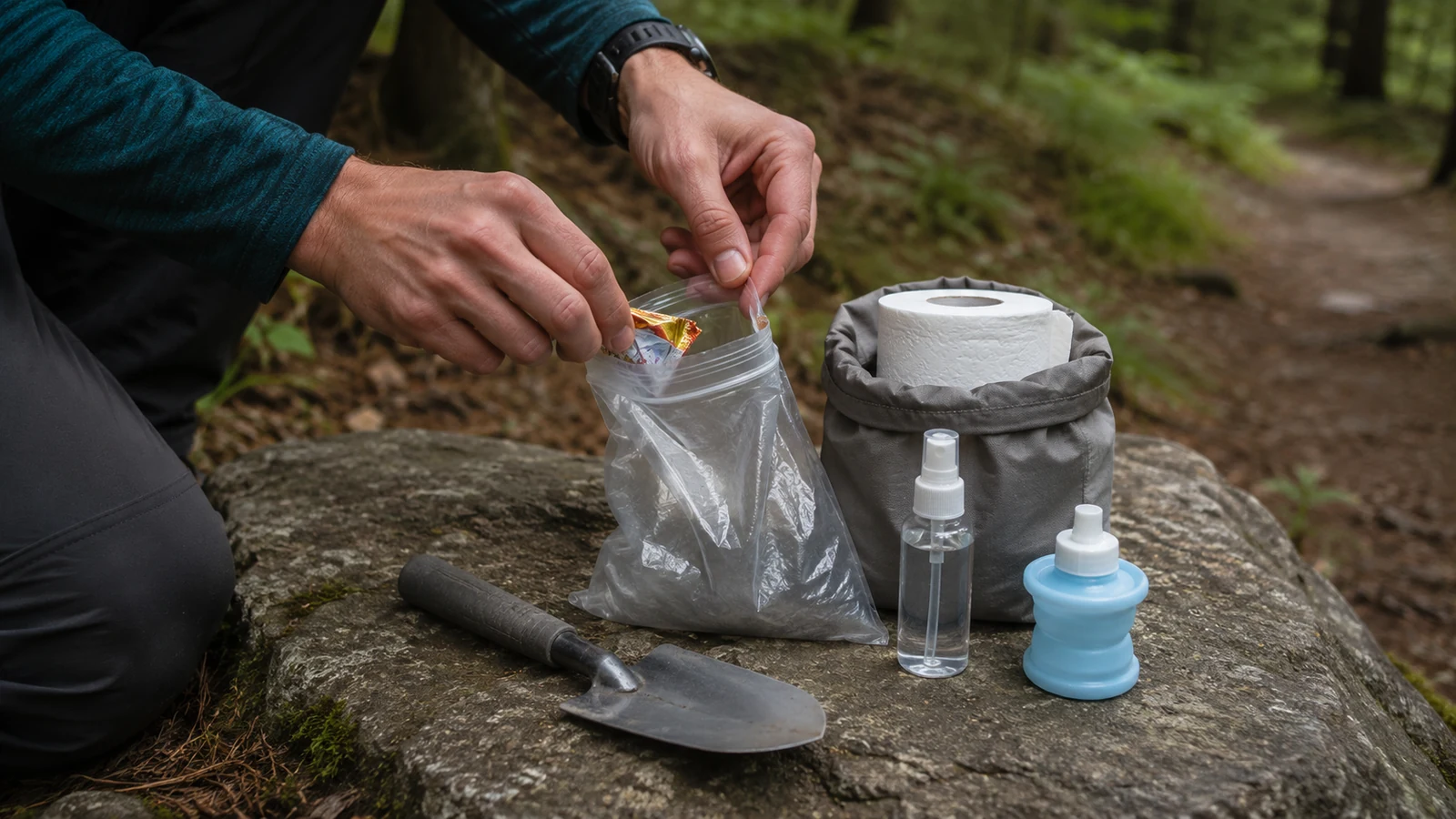
A practical ultralight waste kit
A good lightweight waste setup can include:
- Small trowel
- Toilet paper in a waterproof bag
- Bidet cap or bottle if you use one
- Hand sanitizer
- Sealable trash bag
- WAG bag where required
That is not overkill. That is the minimum for responsible travel.
Cathole standards still matter
Where catholes are allowed, follow local guidance. In general:
- Go well away from water, trails, and camp
- Dig to appropriate depth in suitable soil
- Cover and disguise properly
- Pack out toilet paper if local conditions or regulations require it, and strongly consider doing it everywhere
Food and micro-trash
Ultralight hikers often repackage food, which is good for weight and trash reduction. But it also creates more opportunities for tiny litter:
- Bar corners
- Drink mix tear-offs
- Ramen fragments
- Twist ties
- Tape bits
Micro-trash is still trash. Pack it all out.
Waste mistake to avoid
Do not assume “natural” waste disappears quickly in every environment. Desert, alpine, canyon, frozen-ground, and high-use areas often need stricter methods than forested lowland routes.
4. Leave What You Find Instead of Improving Camp
Minimalist hikers sometimes pride themselves on not carrying camp comforts. That can be good. But it can also lead to “borrowed comfort” from the landscape itself.
Examples include:
- Cutting browse for bedding
- Moving stones to build furniture
- Digging trenches or wind walls
- Collecting “a few” natural souvenirs
- Pulling flowers or branches for photos or camp use
None of that fits Leave No Trace.
Ultralight-specific mindset shift
If your kit is minimal, accept some discomfort instead of modifying the site. That is part of the trade. A thin pad does not justify harvesting vegetation. A tarp does not justify building structures from local materials.
The clean rule is simple: adapt yourself to the site, not the site to yourself.
Campsite-alteration mistake to avoid
Do not normalize “small alterations.” In high-use areas, hundreds of small alterations become a damaged campsite.
5. Minimize Campfire Impacts by Not Treating Fire as Backup Gear
Ultralight backpackers are often ahead of the curve here because many already rely on stoves, cold soaking, or no-cook systems. That is usually better for Leave No Trace.
The problem starts when hikers cut insulation, shelter, or cooking gear too aggressively and quietly turn campfires into a backup plan.
That creates impact fast.
When fires are a poor ultralight choice
Avoid fires when:
- Fires are prohibited
- Wood is scarce
- You are above treeline
- You are in desert terrain
- You are in a heavily used backcountry zone
- Conditions are dry, windy, or high-risk
- You are only making the fire because your clothing or sleep system is too thin
Better minimalist alternatives
- Carry enough insulation to stay warm without fire
- Use a stove or no-cook system
- Go to bed earlier instead of lingering around camp for heat
- Pick sheltered campsites legally and carefully
Tradeoff: morale vs impact
A fire can feel meaningful. It can also blacken rocks, sterilize soil, consume limited downed wood, leave half-burned trash, and encourage campsite expansion. If you want a lighter, cleaner trip, treat fires as exceptional, not default.
Campfire mistake to avoid
Do not burn foil, food wrappers, wipes, or partially wet garbage. Fire does not make trash disappear cleanly.
6. Respect Wildlife With Real Food Storage, Not Wishful Thinking
A smaller pack can make food storage harder. Bear canisters are bulky. Rodent-resistant methods add steps. Odor-proof systems vary in effectiveness. It is tempting to cut corners.
Do not.
Wildlife problems are often learned behaviors caused by repeated human mistakes. Once animals get food-conditioned, both the animals and future hikers pay the price.
Practical food protection choices
Use the method required or most appropriate for the area:
- Bear canister where required or strongly recommended
- Proper hang only where effective, legal, and you know how to do it
- Ursack or similar approved system where allowed
- Rodent-aware storage in shelters and established camps
Decision criteria
Your food storage choice should be based on:
- Regulations
- Species present
- Skill level
- Tree availability
- Trip area pressure and history
Not based on:
- What saves the most volume
- What worked once in a different region
- What “most people probably do”
Wildlife behavior matters too
Respecting wildlife also means:
- Watching from a distance
- Not feeding animals intentionally or accidentally
- Keeping salty gear and food scraps contained
- Avoiding campsites with obvious animal traffic
- Protecting small animals as well as bears
Wildlife mistake to avoid
Do not act as if poor food storage only matters if bears are around. Rodents, foxes, ravens, and other animals get conditioned too, and they can do serious damage to ecosystems and to your gear.
7. Be Considerate of Other Visitors While Traveling Light
Ultralight hikers often move fast and efficiently, which can be a benefit on crowded routes. But speed and efficiency can also create friction.
Leave No Trace includes social impact, not just ecological impact.
What consideration looks like on trail
- Yield politely and predictably
- Do not blast through muddy sections and widen trail edges
- Keep group spread tight enough to avoid taking over the trail
- Camp out of obvious sightlines when appropriate and legal, without creating new impact
- Keep noise low, especially at sunrise, sunset, and near lakes or shelters
Group ultralight dynamics
A single ultralight hiker can have a tiny footprint. A group of six ultralight hikers can still flatten a campsite, monopolize a water source, and dominate the atmosphere around camp.
The principle is the same: measure impact by actual effect, not by gear identity.
Visitor-impact mistake to avoid
Do not assume your setup is low-impact just because it looks small. Noise, crowding, headlamp use, and social pressure all shape other people’s experience outdoors.
Practical Tradeoffs Every Ultralight Hiker Should Think Through
The lightest option is not always the most responsible one. These are the tradeoffs worth evaluating before a trip.
Tarp vs tent
A tarp is often lighter and flexible, but it may tempt you into awkward micro-sites or force closer site selection near trees and features. A tent can make legal, durable site selection easier in some terrain.
Frameless vs framed pack
A frameless pack can be excellent for smaller loads, but if it leads to poor bear-can carry, overloaded shoulders, or unstable movement off balance, it can affect decision-making and terrain travel.
Cold soak vs stove
Cold soaking can reduce fire and fuel concerns, but only if you will actually eat enough and manage containers hygienically. A stove may be more practical and safer in cold or shoulder-season conditions.
Tiny pad vs adequate sleep
An extremely minimal sleep setup may save weight but reduce recovery, leading to worse choices the next day: poor navigation, rushed camp selection, or cutting corners with waste and water management.
Mistakes Ultralight Backpackers Make With Leave No Trace
Here are the most common ones, bluntly:
- Treating a small shelter footprint as permission to camp on fragile ground
- Skipping a proper trowel or sanitation system
- Planning to use fire because insulation is too minimal
- Ignoring bear canister or food-storage rules to save weight
- Creating new campsites instead of using durable existing ones
- Shortcutting muddy trail sections and damaging trail edges
- Leaving micro-trash because it is “tiny”
- Altering campsites to suit minimalist gear
- Overestimating skill and underpacking for weather
- Using “ultralight” as an identity instead of a practical system
A Simple Leave No Trace Checklist for Minimalist Hiking
Before each trip, ask:
- Does my setup let me follow all local regulations?
- Can I stay warm, cook, and sleep without needing a fire?
- Do I have a complete and realistic human waste system?
- Can I store food properly for this specific area?
- Does my shelter choice support camping only on durable legal surfaces?
- Am I light because I am efficient, or light because I omitted necessary gear?
If the answer to any of those is no, your kit needs work.
FAQ
Is ultralight backpacking automatically better for the environment?
No. It can reduce impact, but only if it leads to better behavior. A lighter pack does not offset poor campsite choice, bad sanitation, illegal fires, or careless food storage.
Can I skip a trowel to save weight?
Usually, no. If catholes are legal and appropriate, you still need to dig them properly. In some places you may need to pack waste out entirely. Either way, you need a real plan, not improvisation.
Are tarps less Leave No Trace-friendly than tents?
Not inherently. Tarps can be very low-impact in skilled hands. The issue is behavior: if a tarp encourages you to camp on fragile or cramped spots that should be left alone, then the setup is causing problems.
Is it okay to have a fire if I am an ultralight hiker?
Only when it is legal, low-risk, and environmentally appropriate. A fire should not be part of your essential warmth strategy because you left other gear behind.
What is the biggest Leave No Trace mistake ultralight backpackers make?
Using minimal gear to justify minimal responsibility. The most common version is poor campsite and waste decisions made in the name of saving weight or keeping things simple.
Final Thoughts
Leave No Trace for ultralight backpackers is not a separate set of principles. It is the same 7 principles applied with more discipline. Going lighter can absolutely reduce your footprint, but only when it gives you the freedom to make better choices, not thinner excuses.
The honest standard is this: bring the lightest kit that still lets you camp legally, travel carefully, handle waste properly, avoid fires, protect wildlife, and leave places looking like you were never there. That is real minimalist hiking.
Next Steps in the HikeLab Series
Sources
- REI Co-op
- OutdoorGearLab
- HikeLab Editors
Napište komentář