Part 41 of the HikeLab Ultimate Ultralight Guide Series.
If your sleeping bag says 20F, why do so many campers still wake up shivering at 35F? That mismatch is exactly why sleeping bag temperature rating explained is such an important topic. The number printed on the tag is often not the number most people should shop by, and your sleeping pad, clothing, shelter, and even how tired you are can change how warm that bag feels. A bag that sounds trail-ready in a product listing can feel completely different after a windy setup, a thin pad, and a long day of hiking.
If you’ve ever stood in a gear shop wondering whether a 30F bag is enough, you’re not overthinking it. Most campers are reading the wrong rating and building half a sleep system. That leads to cold nights, expensive upgrades, and a lot of confusion that could have been avoided with a better label and a clearer buying framework. This guide fixes that. You’ll learn what the ratings really mean, how ISO testing works, why the label can be misleading, and how to choose the right bag for the way you actually sleep outside.
Key Takeaways
- A sleeping bag temperature rating is a lab-tested guideline, not a promise that every camper will feel warm at that temperature.
- Most people should buy based on the
comfortrating, not theextremerating and often not the marketed number on men’s or unisex bags. - Your sleeping pad R-value, shelter, clothing, wind, dampness, and metabolism affect warmth almost as much as the bag itself.
- A simple rule works well: start with the expected overnight low, then add a safety buffer if you sleep cold or expect rough conditions.
What a sleeping bag temperature rating actually tells you
A sleeping bag temperature rating is a standardized estimate of how warm a bag can keep an adult sleeper under test conditions. That’s the short version of sleeping bag temperature rating explained. The longer version is that the rating comes from lab testing, not a guarantee of comfort on your next windy ridge or damp forest campsite.
In plain English, the rating tells you how the bag performed when tested in a controlled setup. It does not fully account for your body, your pad, your shelter, or the fact that real campsites are messy.
Forecasts shift. Ground steals heat. Clothing gets sweaty. Fatigue makes you colder.
That’s why two hikers can use the same 20F bag and have very different nights. Maya slept in a 20F bag during a spring trip in Utah and felt fine at 32F. Her partner Ben used a similar bag, but on a thinner pad and after a long wet day, and woke up cold enough to boil water at 3 a.m.
The most useful way to think about ratings is this:
- The lab number is a starting point.
- Your real comfort depends on the full sleep system.
- The safest buying choice usually comes from the comfort side of the rating, not the survival side.
If you’re comparing bags right now, slow down and write down your actual expected overnight lows before you shop. That one step will save you from buying for marketing instead of conditions.
For a solid buyer-guide overview, REI’s backpacking sleeping bag guide does a good job connecting bag warmth to the full sleep system.
Comfort vs limit vs extreme: the ratings that matter most
This is where most confusion starts, so any real sleeping bag temperature rating explained guide has to make these three numbers simple.
Comfort is the lowest temperature at which a cold or average sleeper can remain comfortable in a relaxed position. For many campers, this is the number that matters most. If you sleep cold, this is the rating you should use first.
Limit or lower limit is the lowest temperature at which a warm sleeper can make it through the night in a curled position without feeling cold. This is often the headline number used on men’s or unisex bags. It is not the same as “most people will be comfortable here.”
Extreme is a survival-only number. It is not a buying number. It does not mean “cozy.” It does not mean “safe for a normal trip.” It means the bag may help prevent life-threatening cold for a limited time, often with serious discomfort and real risk still in play.
Here’s the simplest version of sleeping bag comfort rating explained:
- Buy from
comfortif you sleep cold, are new to camping, or hate gambling with sleep. - Use
limitonly if you know you sleep warm and your whole sleep system is dialed in. - Ignore
extremefor shopping decisions.
Advnture explains this part clearly and also notes that the extreme rating is about survival, not comfort:
Chris learned this the hard way on a shoulder-season overnight in Colorado. He bought a bag marketed as 30F and assumed it meant comfortable at 30F. The bag’s useful comfort number was higher, the low hit the mid-30s, and he barely slept. He didn’t need a “warmer sleeper mindset.” He needed to understand comfort vs limit vs extreme sleeping bag ratings before buying.
ISO 23537 explained: how sleeping bags are tested
When people search ISO 23537 sleeping bag, they’re trying to answer one question: can I trust this rating? Usually, a standardized rating is more trustworthy than a brand-only claim.
ISO 23537 is the testing framework used to assess adult sleeping bags under controlled conditions. An older 2016 edition was replaced, and ISO lists a newer ISO 23537-1:2022 version on its site. The point for shoppers is not memorizing the document title. The point is knowing that standardized testing gives you a better apples-to-apples comparison than marketing copy alone.
The test uses a heated manikin in a controlled environment. That setup lets manufacturers estimate ratings like comfort and limit in a repeatable way. It still isn’t perfect, because real people are not mannequins and campsites are not labs, but it is much better than guessing.
Why this matters:
- Standardized testing reduces brand-to-brand guesswork.
- It helps explain why two bags with similar labels can feel different.
- It gives you a better baseline for comparing down bags, synthetic bags, men’s bags, and women’s bags.
If a bag lists ISO-tested ratings, that is a good sign. If a brand gives one bold temperature number with no explanation of comfort or limit, be more skeptical. That doesn’t automatically mean the bag is bad. It means you need more context before trusting the label.
You can read the scope of the standard itself on ISO’s catalogue page for ISO 23537-1.
Why the number on the bag can be misleading
The biggest trap in sleeping bag temperature rating explained is the marketed number itself. Many men’s and unisex bags are sold using the lower-limit number because it looks warmer on paper. Women’s bags are often marketed closer to the comfort number. That makes side-by-side shopping confusing unless you know what you’re looking at.
So if one bag says 20F and another says 20F, they may not mean the same thing in practice. One could be telling you the lower limit for a warm sleeper. The other could be showing a comfort-oriented number for a colder sleeper. Same headline, different experience.
This is why shoppers often say, “I had a 20-degree bag and it definitely was not a 20-degree bag.” Sometimes the bag wasn’t lying. The shopper just didn’t realize which rating the brand chose to highlight.
Lena ran into this before a Sierra trip. She upgraded to a premium down bag labeled 15F and expected a warm cushion for late-season nights. The overnight low stayed above freezing, but she still felt cold because she was looking at the marketed number, not the more useful comfort range, and her pad insulation was too low for granite camps.
The takeaway is simple. Never shop from one big number alone. Look for:
- Comfort rating
- Lower-limit rating
- Whether the bag was ISO tested
- Whether the bag is cut for men, women, or unisex fit
If the product page hides that information, treat the rating as incomplete, not as precise.
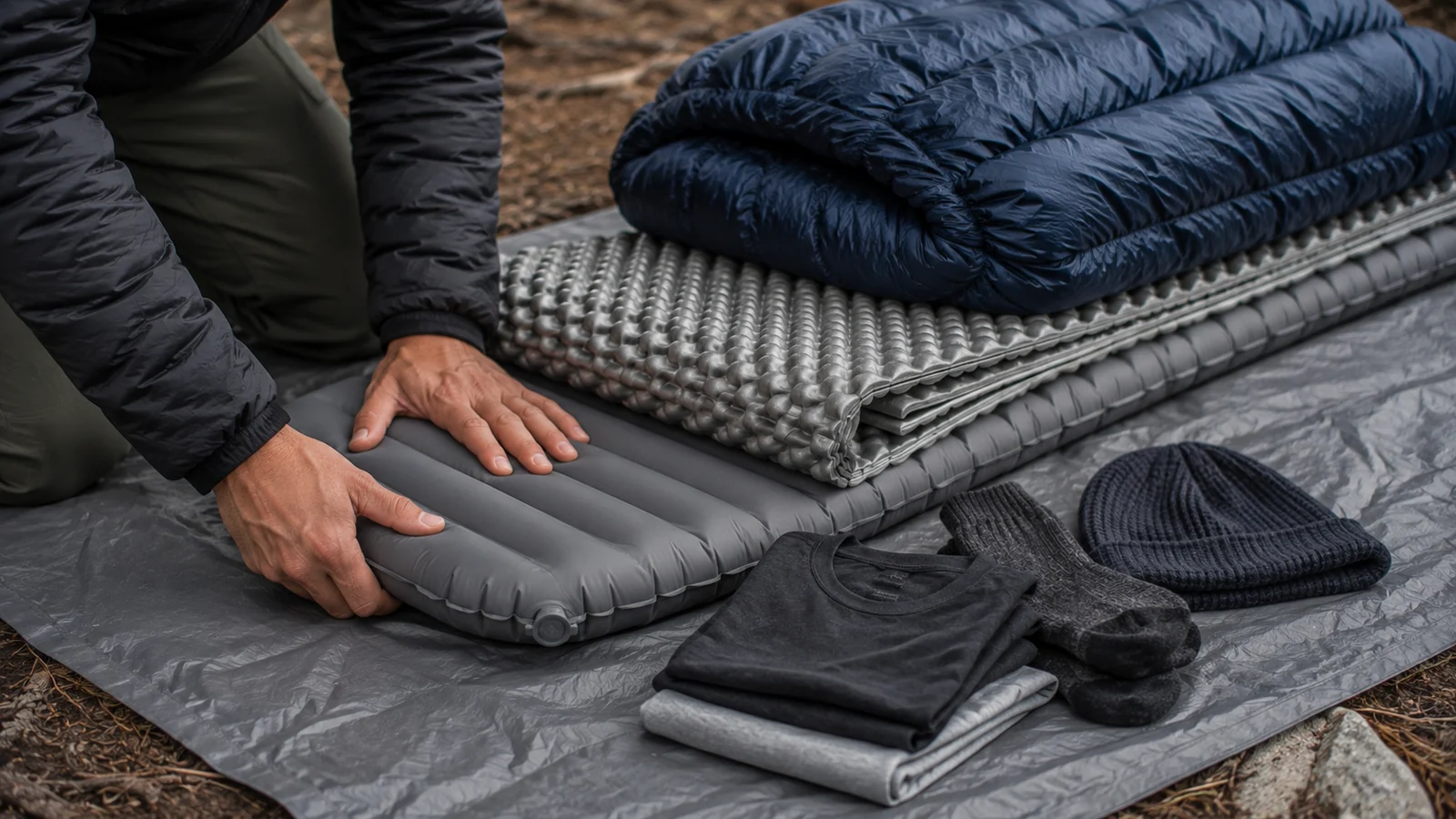
Your sleeping pad, clothing, and shelter matter as much as the bag
This is the section most campers skip, and it’s the reason so many “wrong bag” complaints are really sleep-system problems. A true sleeping bag temperature rating explained article has to say this plainly: the bag only works as part of a system.
Your sleeping pad matters because the ground steals heat fast. Loft under your body compresses, so the bag cannot insulate well underneath you. That’s the pad’s job. A warm bag on a weak pad can still feel cold.
REI makes this point clearly in its backpacking sleeping bag guide, which pairs expected nighttime lows with sleeping pad R-values and bag ratings in the same framework.
Clothing matters too, but not in the way many people think. Dry base layers, warm socks, and a hat can help. Sweaty layers, damp cuffs, or tight clothing that reduces circulation can make you colder. More clothes does not always equal more warmth.
Shelter exposure changes things fast. A calm night in a double-wall tent feels different from a breezy tarp pitch on open ground. Humidity matters. Wind matters. So does the food you ate, how hydrated you are, and whether you’ve been pushing hard all day.
Use this quick reality check before blaming the bag:
- Was your sleeping pad warm enough for the ground temperature?
- Were your layers dry when you got into the bag?
- Were you underfed, dehydrated, or exhausted?
- Was your campsite exposed to wind or damp air?
If you want to improve your sleep faster than buying a new bag, audit the full system first. That is often the cheaper fix and the smarter one.
The fastest way to see this for yourself is to keep the bag constant and change one variable at a time across a few nights: the same bag on a R 2 pad, then on a R 5 pad, then with dry socks and a hat. The pad swap usually produces the biggest single change, which is why pad upgrades fix more cold nights than bag upgrades do.
How to choose the right temperature rating for warm and cold sleepers
Now for the part most readers actually need: how to choose sleeping bag temperature rating for a real trip.
Start with the expected overnight low, not the daytime high, not the season label, and not the best-case forecast. Use the lowest realistic nighttime temperature for the place and time of year you’re camping.
Then apply this simple formula:
- Start with the expected overnight low.
- If you sleep cold, add a
10Fsafety buffer. - If you sleep warm, you may be able to use the lower-limit number, but only with a solid pad and proven setup.
- If weather is wet, windy, high-elevation, or uncertain, add more margin.
Here are a few examples:
- Forecast low
45F, warm summer camping, warm sleeper: a bag with about a40Fcomfort range may work. - Forecast low
32F, average sleeper, solid three-season pad: a20Fto30Fcomfort-oriented bag is usually a safer choice. - Forecast low
25F, cold sleeper, shoulder season: a15For warmer comfort-focused setup makes more sense than gambling on a30Flimit-rated bag.
Backpacking Mastery offers a practical buying angle here and treats a 20F bag as a versatile three-season default for many backpackers:
If you’re buying one bag to cover most backpacking trips, this is the place to be honest about who you are as a sleeper. Don’t shop for your toughest self on your best night. Shop for your average night when you’re tired, a little damp, and camped a bit higher than planned.
Best sleeping bag ratings by season, trip type, and overnight low
There isn’t one perfect rating for every trip, but there are useful patterns. This section turns sleeping bag temperature ratings into faster decisions.
For warm summer car camping, many people are fine with a 40F to 50F bag, especially when they have thick pads, extra blankets, and easy bailout options. Comfort matters more than weight here.
For summer backpacking in mountains, a 30F bag is often safer than a 40F bag because alpine lows surprise people. A bag that feels slightly warm is easier to vent than a bag that is not warm enough.
For general three-season backpacking, a 20F bag remains the classic do-most-things choice. That doesn’t mean every backpacker needs one. It means a 20F setup gives many people enough margin for spring, summer at elevation, and early fall.
For shoulder season or cold sleepers, something around 10F to 20F can be more realistic. For true winter camping, you are in a different category entirely and should build a dedicated system around deep-cold conditions, higher pad R-values, and conservative safety margins.
Here’s a quick rule-of-thumb chart:
| Trip type or condition | Common overnight low | Practical bag target |
|---|---|---|
| Warm summer car camping | 50F+ | 40F to 50F comfort-oriented |
| Mild summer backpacking | 40F to 50F | 30F to 40F comfort-oriented |
| Mountain summer backpacking | 30F to 40F | Around 20F to 30F |
| General three-season use | 25F to 40F | Around 20F |
| Shoulder season or cold sleeper | 15F to 30F | 10F to 20F |
| Winter camping | Below 15F | Dedicated winter system |
This chart is not a substitute for judgment. It is a starting point. Your pad, shelter, elevation, and metabolism still matter.
If you’re choosing between two bags and one gives you slightly more margin without wrecking pack weight, that is usually the better long-term buy.
Common buying mistakes that lead to cold nights
Most bad sleeping bag purchases are not random. They come from a few repeat mistakes, and a strong sleeping bag temperature rating explained guide should call them out directly.
Mistake one is buying from the extreme number. That number should not drive normal trip planning. If it is the reason a bag looked like a bargain, it probably was not a bargain.
Mistake two is ignoring the sleeping pad. This is probably the biggest real-world error. A premium bag on a low-insulation pad can still underperform badly.
Mistake three is assuming all brands rate the same way. Some brands are clear about comfort and lower limit. Others highlight one number and make you hunt for the rest.
Mistake four is buying for the lowest weight instead of the trip. Saving a few ounces does not help if you stop sleeping well and start dreading cold nights.
Mistake five is forgetting fit. A bag that is too roomy can feel colder because you have more air space to warm. A bag that is too tight can compress insulation and reduce loft.
A final mistake is assuming you can “wear your way out” of an underpowered bag. Extra layers help, but they are not magic. If the sleep system is badly mismatched, clothing only patches the problem.
Before you click buy, use this five-point check:
- What is the comfort rating?
- What nighttime low am I truly planning for?
- What pad R-value will I use with it?
- Do I sleep warm, average, or cold?
- Am I buying for comfort or just the smallest packed size?
If you can answer those questions clearly, your odds of buying the right bag go way up.
FAQ
What does a sleeping bag temperature rating mean?
It means the bag reached a certain warmth estimate under controlled test conditions. It is a guideline for comparison, not a guarantee that every camper will feel warm at that temperature in the field.
Why do I feel cold in a bag rated warmer than the forecast?
The usual reasons are a low-R-value pad, damp clothing, wind exposure, fatigue, hunger, or using the lower-limit number as if it were a comfort number.
Which sleeping bag rating should I trust most?
For most campers, the comfort rating is the safest number to trust first. Warm sleepers with a proven setup may use the lower-limit rating more confidently, but the extreme rating should not guide a normal purchase.
How do I choose the right sleeping bag temperature rating?
Start with the expected overnight low, then add margin for being a cold sleeper or for rough conditions. Make sure your pad and shelter match that choice so the full sleep system supports the bag.
When should I choose a 20F sleeping bag?
A 20F bag is often the most versatile choice for general three-season backpacking, especially if you camp at elevation, travel in shoulder seasons, or want one bag that covers a wide range of nights.
Next Steps
- Read Ultralight Sleep Systems for the full quilt vs bag comparison.
- Check R-Value Explained to understand pad insulation alongside bag warmth.
- Review Quilt vs Sleeping Bag for the practical decision guide.
Sources
- REI — How to Choose a Backpacking Sleeping Bag — comfort vs limit ratings in buying terms
- ISO 23537-1 — Sleeping Bags: Thermal and Dimensional Requirements — the testing standard behind the numbers
- Therm-a-Rest — What Is R-Value? — how pad insulation stacks with bag warmth
- National Park Service — Hypothermia Safety — why cold-night margin is a safety decision
Einen Kommentar hinterlassen