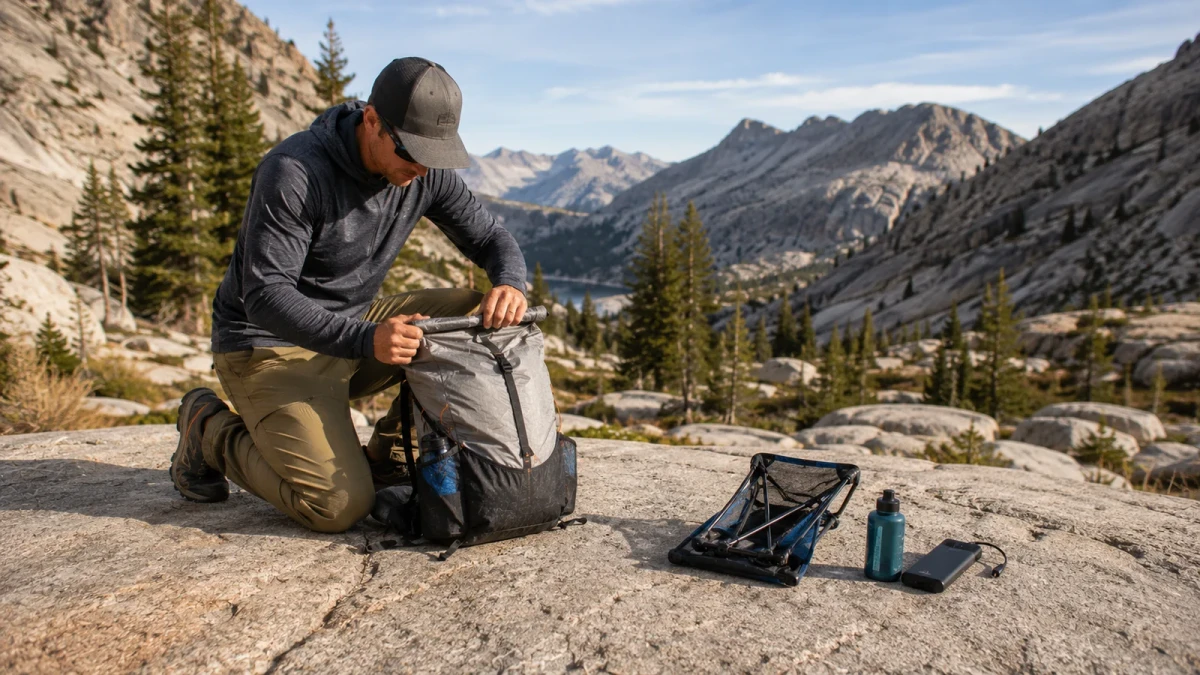
Part 43 of the HikeLab Ultimate Ultralight Guide Series.
If your shoulders are cooked before lunch, you probably do not need a harder workout plan. You need to learn how to reduce backpacking pack weight before your next trip. Most hikers are carrying an extra 2 to 4 kg (5 to 10 lb) without realizing it, and that extra load usually comes from a few bad decisions, not from one giant mistake. A lighter pack changes your whole day: easier climbs, steadier descents, and fewer miserable breaks to readjust straps.
That is the good news. If you know where to look, you can cut meaningful weight fast without turning your kit into an uncomfortable ultralight experiment. This guide agrees with the problem, promises a practical fix, and previews the smartest path forward: weigh what you have, fix the biggest gear first, trim the silent extras, and keep the items that protect sleep, safety, and weather margin.
By the end, you will know how to lower base weight backpacking in the right order, where the easiest free savings are hiding, and when a lighter pack becomes a worse pack. The goal is simple: hike easier and finish the day with more energy left.
Key Takeaways
- The fastest way to reduce backpacking pack weight is to audit your current kit and fix the heaviest categories first.
- Most meaningful savings come from the shelter, sleep system, backpack, and pad, not from obsessing over tiny accessories.
- Food, water, clothing, toiletries, and duplicate gear quietly add several pounds when you do not plan them carefully.
- Smart lightweight backpacking keeps safety, weather protection, and sleep quality intact instead of cutting them for bragging rights.
Why Your Backpack Feels Heavy: Base Weight vs. Total Pack Weight
Before you reduce backpacking gear weight, you need to know what you are actually measuring. Backpacking base weight means everything in your pack except food, water, and fuel. Total pack weight is what you carry at the trailhead, including those consumables.
That distinction matters because many hikers think their gear is the whole problem when the real issue is a mix of heavy gear and sloppy planning. If your base weight is 8 kg (17.5 lb) and you add 3 liters of water, two days of food, and a full fuel canister, your pack can feel brutally heavy even if each item seems “reasonable” on its own.
One liter of water weighs about 1 kg (2.2 lb). That means two extra liters add more weight than many hikers save with an expensive gear upgrade. This is why learning how to lighten a backpacking pack is not just about shopping. It is about knowing the difference between fixed gear weight and trip-specific weight.
Here is the simple framework:
- Base weight is your core kit.
- Consumables are food, water, and fuel.
- Total pack weight is what your body actually feels.
- The best savings come from improving both the core kit and your trip planning.
If you want a benchmark, a lightweight overnight setup often lands around 4.5 to 8 kg (10 to 18 lb) of base weight, while many ultralight hikers target under 4.5 kg (10 lb). You do not need to chase that number. You just need to stop carrying weight that does not earn its place.
How to Reduce Backpacking Pack Weight Fast: Start With a Pack Audit
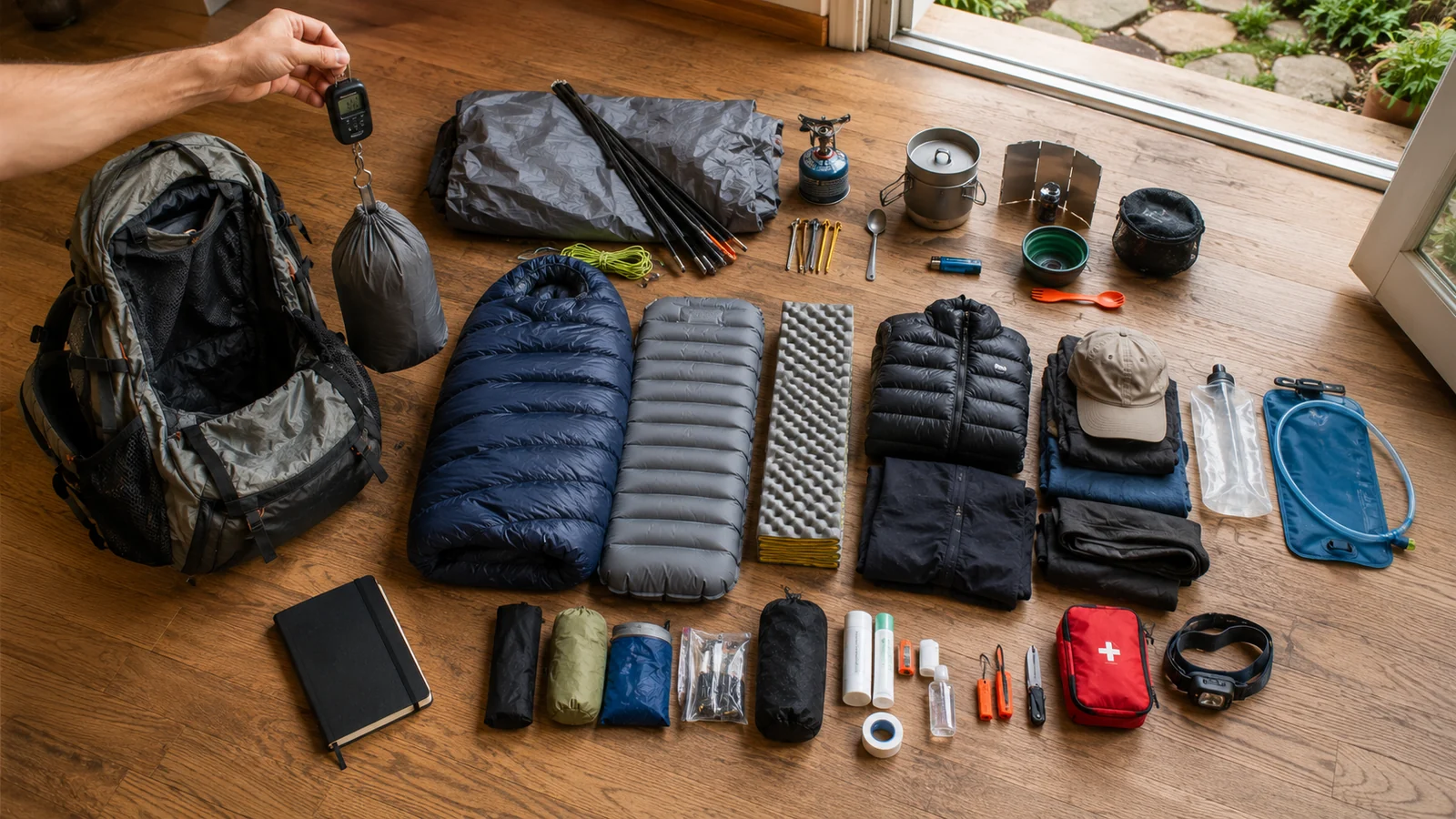
The fastest way to reduce backpacking pack weight is to stop guessing. Lay out every item you normally bring, weigh it, and write it down.
The advantage comes from turning this into a system. Sort every item into categories: shelter, sleep, pack, clothing, kitchen, water, electronics, hygiene, and safety. Then highlight the top five heaviest items and the top five “why am I carrying this?” items.
Use a three-part decision for each piece:
- Remove it if you do not use it.
- Replace it if it is unusually heavy for its job.
- Repackage it if the full-size version is the problem.
That process is how to reduce backpacking pack weight without overcomplicating the job. You do not need perfect data. You need honest data.
Take Maya, who was training for a two-night Smokies loop. Her audit showed a 900 g camp chair, extra clothing, a full bottle of sunscreen, and a 20,000 mAh battery bank for a weekend with no camera work planned. She cut 1.8 kg (4 lb) before buying anything.
Here is the short answer:
The fastest way to reduce backpacking pack weight is to fix the biggest items first, not the tiniest ones. Weigh everything in your pack, focus on your shelter, sleep system, backpack, and pad, cut duplicate clothing and toiletries, and only carry the food and water you need between reliable refill points.
Follow these four steps:
- Weigh every item in your pack.
- Sort the gear by category and mark the biggest offenders.
- Decide whether each heavy item should be removed, replaced, or repackaged.
- Test the new list on a short shakedown hike before your next big trip.
Before you buy a single new item, do a full pack audit tonight and circle the five pieces doing the most damage.
How to Reduce Backpacking Pack Weight by Fixing the Big Four
If you want big savings, fix the Big Four: shelter, sleep system, backpack, and sleeping pad. These items usually dominate your backpacking base weight, which makes them the highest-return place to focus.
Start with the shelter. Many older backpacking tents weigh 2.3 to 3.2 kg (5 to 7 lb), while modern one- or two-person shelters can cut that by 700 g to 1.4 kg (1.5 to 3 lb). You want a better weight-to-weather-protection ratio, not the lightest shelter on the market.
Next is your sleep system. Heavy synthetic bags, oversized pads, and redundant sleep clothing stack weight fast. A well-chosen quilt or lighter bag, paired with a pad that still keeps you warm, can remove another 500 g to 1 kg without turning your nights miserable.
The backpack itself often comes third, not first. Many hikers buy a smaller, lighter pack before shrinking the rest of the kit, then discover the new pack does not carry their current load well. Reduce the big gear first, then choose a pack that matches the new volume and load, as REI’s ultralight backpacking basics recommends.
Jordan learned that the expensive way. He bought a frameless pack to replace a 1.8 kg model, but his old tent and sleeping bag still took up too much space and weight. After swapping the shelter and bag first, he moved into a smaller framed pack later and cut nearly 3.2 kg (7 lb) total.
Do not ignore the pad. A lighter inflatable or foam setup can save another 200 to 500 g and free up volume at the same time.
If you are asking how to lower base weight backpacking without making 30 different changes, this is the answer. Fix the Big Four first, then clean up the rest.
Reduce Food, Water, and Fuel Weight Without Doing Anything Stupid
Trail weight changes every day, which makes it the easiest place to save weight and the easiest place to make dumb mistakes. Food, water, and fuel should be planned with the route, the weather, and your own appetite in mind, not vague anxiety.
Start with food. Backpackers often carry too much because they never track what they actually eat. For most trips, calorie-dense foods like nuts, tortillas, hard cheese, olive oil, bars, and dehydrated meals give you more energy for less carried weight than bulky snacks with lots of air and water in them.
Water planning matters even more. If you are hiking a wet trail with regular sources and a reliable filter, carrying an unnecessary extra 2 liters means adding about 2 kg (4.4 lb) for no good reason. On a hot, dry stretch, the opposite is true, and under-carrying becomes a safety problem.
Ben figured this out on a summer trip in Idaho. He used to leave every trailhead with 4 liters because it felt safer. After checking recent trail reports and marking refill points on his map, he usually carried 1.5 to 2 liters between known sources and took more only on dry stretches.
Fuel is a smaller category, but it still counts. If you are doing quick overnights, simple boil-only meals often mean a smaller stove setup and less fuel. If you hate cold food, do not force a cold-soak system just because it sounds ultralight.
A few guardrails matter here:
- Carry extra water in extreme heat, exposed ridgelines, and long dry sections.
- Carry extra food when weather, pace, or route complexity could slow you down.
- Carry the fuel you need for your actual meal plan, not for imaginary gourmet camp cooking.
- Keep a reliable water treatment method even on shorter trips.
This is how to lighten a backpacking pack the smart way. You cut the extra weight that comes from poor planning, not the margin that keeps you functioning.
Stop Overpacking Clothing, Toiletries, Electronics, and “Just in Case” Extras
This is where medium-size mistakes become a multi-pound problem. Most hikers do not carry one absurd extra item. They carry ten smaller extras that feel harmless until the whole pile hits their shoulders.
Clothing is the most common offender. You usually need one hiking outfit, one insulation layer, one rain layer, and sleep clothes only when the conditions or your comfort truly justify them. A second hiking shirt, backup pants, spare fleece, and camp shoes are often dead weight.
Toiletries are another easy win. Repackage sunscreen, soap, toothpaste, and bug repellent into smaller containers instead of tossing in the full-size version. A tiny repair kit and first-aid kit make sense, but a pharmacy aisle in a zip pouch does not.
Electronics are heavier than people admit. Phones, headlamps, cords, battery banks, cameras, and satellite devices add up fast. Bring the tools you actually use, then match the battery size to the trip length.
Leah learned this before a three-day trip in Slovenia. Her “small stuff” pile included a mirrorless camera, tripod, power bank, camp lantern, speaker, two charging cables, and a second headlamp. She cut the list to a phone, one headlamp, one short cable, and a smaller battery bank, and dropped almost 900 g.
The same rule applies to “just in case” extras. One backup system is smart when failure would matter. Three vague backup items are usually fear packed into nylon pouches.
Empty your ditty bag and electronics pouch on the floor. If an item has not been used in your last two trips and is not safety critical, make it defend its spot.
Use Multi-Use Gear and Shared Gear to Cut Redundancy
Once the obvious heavy items are handled, the next step is reducing duplication. Multi-use gear and shared gear help you stop carrying two things that solve the same problem.
Trekking poles can support a shelter. A phone can cover navigation, photos, notes, and reading. A buff can work as sun protection, a sleep mask, a towel substitute, or extra warmth around the neck. None of those choices are extreme, but together they are an effective way to reduce backpacking gear weight.
Shared gear matters even more for pairs and small groups. Two hikers do not both need a stove, pot, full repair kit, or water filter if they are staying together. Split the tent body and poles, share the kitchen, and decide who carries which safety or water items before the trip starts.
The trick is to share intentionally. If you split key gear, make sure both people understand the system.
This is where ultralight backpacking tips become less about buying new gear and more about packing with discipline. Every duplicate item should answer one question: what exact problem does this solve that nothing else already covers? If you cannot answer that clearly, the item probably does not belong.
What Not to Cut: Safety, Weather Protection, and Sleep Quality
Lightweight backpacking has a hard line: some weight is worth carrying. If your kit gets lighter but your sleep collapses, your weather margin disappears, or your safety tools vanish, you did not solve the problem.
Do not cut your insulation below the conditions you expect. Do not cut real rain protection because the forecast looks “mostly fine.” Do not cut navigation, illumination, first aid, or water treatment just to hit an aesthetic base-weight number. The Leave No Trace seven principles still apply when your pack is smaller.
Some trips require extra weight on purpose. Cold-weather routes, shoulder-season alpine trips, long dry stretches, beginner trips, and high-bug-pressure conditions often justify more shelter, more warmth, or more water capacity. Bear-canister zones are another clear exception. In places like Yosemite, bear-resistant food storage rules are not optional.
This is where “light, not stupid light” becomes useful. A bad night of sleep can wreck your pace the next day. A missing warm layer can turn a mild discomfort into a real risk.
If you are new to this, protect three things first: warmth, weather protection, and sleep. You can always trim more later after a few honest shakedown trips tell you what you actually use.
A Budget Plan to Drop 5 to 10 Pounds From Your Pack
Most hikers do not need a full gear overhaul. They need a weight-savings ladder: free changes first, cheap swaps second, premium upgrades last.
Here is a practical roadmap:
- Free fixes: weigh everything, remove duplicates, repackage toiletries, trim excess clothing, carry only the needed water between known sources, and stop bringing luxury items you do not use.
- Low-cost swaps: replace heavy dry bags with lighter storage, shrink the battery bank, choose a lighter cook kit, buy smaller containers, and use trekking poles or shared gear more effectively.
- Premium upgrades: replace the heaviest shelter, sleeping bag or quilt, backpack, or pad if one of those items is clearly outdated or oversized.
This is how to reduce backpacking pack weight without blowing up your budget. A free cleanup often removes 1.4 to 2.3 kg (3 to 5 lb). One smart major upgrade can remove another 700 g to 1.8 kg.
Elena followed that exact ladder over one season. First she dropped 1.6 kg by cutting duplicates and repackaging small items. Then she replaced an old tent and bulky sleeping bag, and by autumn she had removed just over 4 kg (9 lb).
If you are trying to reduce backpacking gear weight on a tight budget, do not waste money chasing one-ounce wins. Spend where the scale moves.
Pick one free fix and one paid upgrade before your next trip. That pairing usually gives the fastest real-world result.
FAQ
How much should a backpacking pack weigh for a weekend trip?
There is no single perfect number, but many weekend backpackers feel a big improvement once their base weight drops into the 4.5 to 8 kg (10 to 18 lb) range. Your total pack weight will still rise with food and water, so route conditions matter.
What is the fastest way to reduce backpacking pack weight?
The fastest way is to weigh everything, identify the biggest offenders, and fix the shelter, sleep system, backpack, and pad before you worry about tiny accessories. After that, cut duplicate clothing, toiletries, and unnecessary electronics.
Why does my pack still feel heavy after buying lighter gear?
Because lighter gear in one category does not solve overpacking in the rest of the kit. Many hikers buy a lighter tent but still carry too much water, too many clothes, or a pile of backup items.
Which backpacking items should I replace first to lower base weight?
Replace the heaviest item that gives you the biggest safe savings, which is usually your shelter, sleeping bag or quilt, backpack, or pad. Smaller accessories should come later unless one of them is obviously absurd for the trip.
When should I stop cutting weight and carry more instead?
Stop cutting when the lighter setup starts hurting your warmth, sleep, hydration, weather protection, or route safety. Add weight back for cold weather, long dry carries, bear-canister requirements, beginner trips, and any route where a mistake could get expensive.
Cut Weight in the Order That Actually Pays
Learning how to reduce backpacking pack weight is mostly about fixing decisions, not proving toughness. The biggest wins come from a simple order of operations: know your backpacking base weight, audit what you carry, fix the Big Four, then clean up food, water, clothing, and the small extras that pile on quietly.
You do not need to become an ultralight purist to feel the difference. If you cut 2 to 4 kg from your pack while keeping the gear that protects sleep, warmth, weather margin, and safety, the trail gets better fast. It also gives you more room to adapt when the weather shifts or the day runs longer than planned.
Start with one action today. Weigh your current kit, remove the obvious dead weight, and choose the single upgrade that will save the most weight for the least regret. That is how to reduce backpacking pack weight in a way that lasts. A lighter pack gives you more energy, more confidence, and more room to enjoy the trip.
Next Steps
- Read The First Kilogram to Cut for the fastest single kilo most hikers can drop.
- Check The Ultimate Base Weight Guide to set a realistic target number.
- Review How to Pack a Backpack for Ultralight Hiking so the lighter kit also carries better.
Sources
- REI — Ultralight Backpacking Basics — base weight targets and upgrade order
- National Park Service — Ten Essentials — what should never be cut for weight
- Leave No Trace — Seven Principles — repackaging, waste, and camp habits
- National Park Service — Hypothermia Safety — where cutting insulation becomes a risk
Einen Kommentar hinterlassen