Part 45 of the HikeLab Ultimate Ultralight Guide Series.
Cutting six ounces from your cook kit feels smart until you spend half the night cold, numb, and awake. That is why the best sleeping pads for ultralight backpacking are not simply the lightest pads on a spreadsheet. They are the lightest pads that still keep your hips off the ground, your body heat in the system, and your next day on track.
If you have been bouncing between R-values, thickness charts, and endless review lists, you are not overthinking it. Sleeping pads are one of the hardest ultralight purchases to get right because every ounce saved changes comfort, warmth, packed size, and failure risk. This guide will make the decision easier. You will see the best current picks by use case, what really counts as ultralight, how much insulation you actually need, and when a few extra ounces are worth carrying.
You do not need a gear spreadsheet with forty tabs. You need a short list, clear rules, and a pad that matches the way you really sleep on trail.
Key Takeaways
- The Therm-a-Rest NeoAir XLite NXT is still the best overall pick for most hikers because it nails the warmth-to-weight sweet spot.
- A realistic three-season target is usually
R 3toR 5, while cold sleepers and shoulder-season hikers are safer atR 5+. - Side sleepers often do better with a slightly thicker pad like the Sea to Summit Ether Light XR, even if it adds a few ounces.
- The best ultralight sleeping pad is the one that helps you recover night after night, not the one with the most aggressive listed weight.
Best Sleeping Pads for Ultralight Backpacking at a Glance
Quick answer: if you are shopping for the best sleeping pads for ultralight backpacking, aim for a pad that weighs about 11 to 16 ounces, has an R-value between 3 and 5.5, and is thick enough for your sleep position. Go lower for hot summer trips. Go higher for cold sleepers, alpine camps, and shoulder season.
- Summer:
R 1-2 - Typical 3-season:
R 3-5 - Cold sleepers or shoulder season:
R 5+ - Winter or stacked systems:
R 6+
| Pad | Best for | Weight | R-value | Why it stands out |
|---|---|---|---|---|
| Therm-a-Rest NeoAir XLite NXT | Best overall | 13 oz regular | 4.5 | Excellent warmth-to-weight, compact pack size, proven thru-hike appeal |
| NEMO Tensor All-Season | Best quiet all-rounder | 14.1 oz regular mummy | 5.4 | Quiet design, strong insulation, stable feel |
| Sea to Summit Ether Light XR | Best for side sleepers | 15.7 oz small | 4.1 | Plush 3.9 in thickness makes rough camps easier |
| EXPED Ultra 3R | Best budget inflatable | 15.9 oz medium | 3.2 | Good comfort, low bulk, fair price for a true trail pad |
| NEMO Switchback | Best foam pad | 14.5 oz regular | 2.0 | Zero puncture risk, instant setup, great backup layer |
| NEMO Tensor Elite | Lightest serious option | 8.5 oz regular mummy | 2.4 | Real gram-counting weight without going torso-length |
| Therm-a-Rest NeoAir XTherm NXT | Best for cold sleepers | 15.5 oz regular | 7.3 | Huge warmth margin for very little added weight |
Here is the fast shortlist:
- Choose the NeoAir XLite NXT if you want one pad that covers most three-season trips well.
- Choose the Tensor All-Season if pad noise or cold ground has ruined your sleep before.
- Choose the Ether Light XR if you are a side sleeper who keeps bottoming out on thinner pads.
- Choose the Ultra 3R if you want a capable inflatable without paying flagship prices.
- Choose the Switchback if durability and simplicity matter more than plush comfort.
- Choose the Tensor Elite if every ounce matters and your trips stay mild.
- Choose the XTherm NXT if you sleep cold or want one pad that stretches into much colder conditions.
Best Sleeping Pads for Ultralight Backpacking by Use Case
If you want one answer and want it fast, start with the Therm-a-Rest NeoAir XLite NXT. REI lists the regular at 13 ounces, 3 inches thick, and R 4.5. That is exactly why it keeps showing up in serious ultralight kits. It is light enough for ounce-counters, warm enough for most three-season trips, and compact enough to disappear into a small pack.
The NEMO Tensor All-Season is the best pick for hikers who want a quieter feel with a little more warmth baked in. NEMO lists the regular mummy at 14.1 ounces, 3.5 inches thick, and R 5.4. If your camps often drift into the 30s, that extra margin matters more than the spec sheet makes it sound.
For the best sleeping pad for side sleepers backpacking, the Sea to Summit Ether Light XR deserves a hard look. Sea to Summit lists the Small at 15.7 ounces, R 4.1, and 3.9 inches thick. That height is the real selling point. If your hips usually push through thinner pads, those ounces can buy a much better morning.
Maya learned that on a Colorado Trail section hike. She chased the lightest pad she could find, then spent two nights waking up every time her hip touched the ground. Before her next trip, she moved to a thicker pad, slept through two cold nights near treeline, and finished the weekend without the lower-back ache she had started treating as normal.
If price matters, the EXPED Ultra 3R is one of the easiest recommendations in this category. EXPED lists the medium at 450 g, which is about 15.9 ounces, with an R-value of 3.2 and 7 cm thickness. It is not the lightest option here, but it gives newer hikers a practical inflatable without dropping into bargain-bin gear that feels cold or flimsy.
If you want a foam option, the NEMO Switchback is the best ultralight sleeping pad for simplicity. NEMO lists the regular at 14.5 ounces with R 2. Foam will not feel luxurious, but it cannot pop, it sets up in seconds, and it doubles as a sit pad or backup insulation layer when conditions shift.
For strict warm-weather gram counters, the NEMO Tensor Elite is the specialist tool. NEMO lists the regular mummy at 8.5 ounces, 3 inches thick, and R 2.4. That is impressive, but it is also a narrow-margin choice. It works best for hikers who know their temperatures and accept less cushion for error.
Cold sleepers should go straight to the Therm-a-Rest NeoAir XTherm NXT. REI lists the regular at 15.5 ounces, 3 inches thick, and R 7.3. That warmth-to-weight ratio is hard to beat if you camp high, run cold, or want one pad that can cover more months of the year.
Ben found that out on an October loop in the White Mountains. He brought a lighter summer pad to save weight, spent most of the night shivering, and hiked out tired and slow the next day. On his next trip he carried a warmer pad, added a few ounces, and said the difference felt larger than upgrading his quilt.
If most of your trips land between 35F and 50F, stop chasing edge-case weight savings. Pick a proven three-season inflatable in the R 4 to R 5.5 range and focus on width, thickness, and how you actually sleep.
What Actually Counts as an Ultralight Sleeping Pad?
Plenty of brands call a pad ultralight because it is lighter than car-camping gear. That is not useful. In real trail terms, an ultralight backpacking sleeping pad usually falls into one of three zones.
The first zone is the specialist zone: about 7 to 10 ounces. Pads here save serious weight, but they usually give up warmth, width, or durability margin. The Tensor Elite lives here.
The second zone is the true sweet spot for most buyers looking for the best sleeping pads for ultralight backpacking: roughly 11 to 16 ounces. This is where you find pads like the NeoAir XLite NXT, Tensor All-Season, and XTherm NXT. They are still light, but they leave room for actual sleep quality.
The third zone is the comfort edge: around 16 to 21 ounces. Some ultralight purists reject this range. That is fine. Real hikers still buy these pads because better sleep can be worth far more than a three-ounce spreadsheet win.
Packed size matters too. A pad that disappears into roughly a one-liter-bottle footprint changes the size of pack you can carry and how cleanly your whole kit rides. That is one reason high-end inflatables keep dominating this category. Low bulk affects the entire system, not just the sleep setup.
How to Choose the Best Sleeping Pads for Ultralight Backpacking
If you only compare listed weight, you will probably buy the wrong pad. The four specs that matter most are R-value, width, thickness, and shape.
Start with sleeping pad R-value for backpacking. The easy rule is simple. Warm summer hikers can often live with R 1 to R 2. Most three-season hikers should sit in the R 3 to R 5 band. Cold sleepers, shoulder-season users, and anyone camping on cold ground should think R 5+.
Width is the next big decision. A 20-inch pad saves ounces, but it is unforgiving if you move in your sleep. A 25-inch pad adds weight, yet it often fixes the constant sliding-off feeling that makes a good quilt feel drafty and a decent night feel broken.
Nora ran into that on the Wonderland Trail. She kept blaming her quilt for cold leaks, but the real problem was that she was half-rolling off a narrow pad every night. When she switched to a wider pad for her next trip, the drafts dropped, her shoulders stayed supported, and she stopped waking up angry at 2 a.m.
Thickness matters most for side sleepers and rough camps. Around 3 inches is the modern ultralight standard. Around 3.5 to 4 inches is where comfort starts to feel noticeably more forgiving, especially if you camp on compacted tent pads, rockier sites, or hard alpine ground.
Shape is the last piece. Mummy pads save weight and pack space. Rectangular pads give you more usable surface, which often matters more for restless sleepers, broader shoulders, and quilt users.
Use these rules:
- Choose
R-valueby your expected ground conditions, not just the air temperature. - Choose width by how much you toss and turn.
- Choose thickness by whether you sleep on your side or your back.
- Choose shape by whether you value max efficiency or max usable space.
Before buying, write down your last five backpacking nights. Note the low temp, your sleep position, and whether you felt cold from above or below. That five-minute audit usually makes the right pad obvious.
Inflatable vs Foam vs Torso-Length Pads
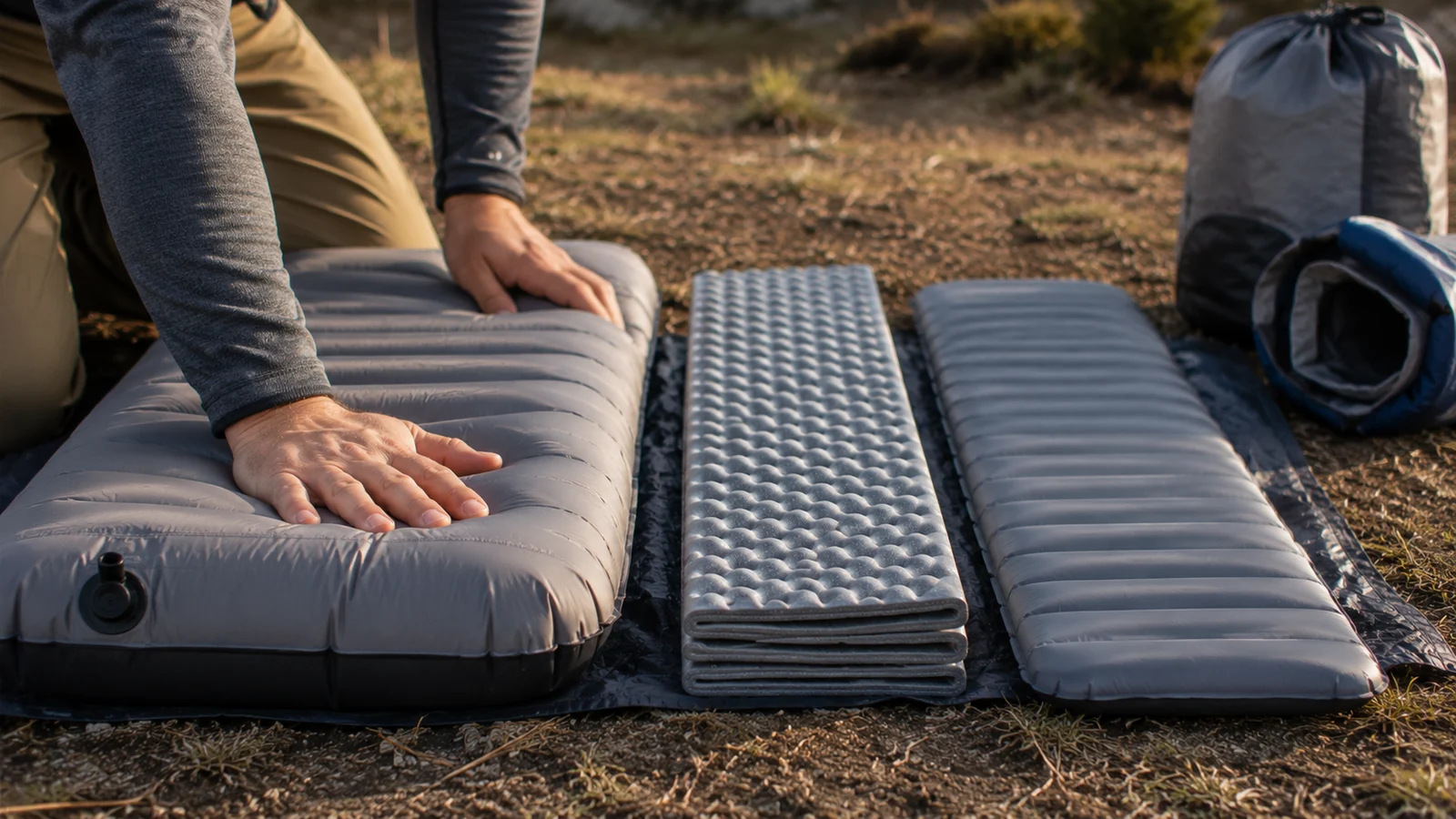
Inflatable pads dominate the best sleeping pads for ultralight backpacking because they offer the strongest comfort-to-weight ratio. You get real thickness, decent insulation, and a compact packed size in one piece of gear. The tradeoff is obvious: they can puncture, and they take a little time to inflate, tune, and protect.
Foam pads sit at the opposite end. They are durable, cheap, and instantly usable. That is why the NEMO Switchback and the Therm-a-Rest Z Lite Sol still matter. They are especially useful for hikers who hate failure risk more than they miss plush comfort.
Torso-length pads are the minimalist wildcard. They can work in warm conditions, especially if you use your empty pack or spare clothing under your legs. They also create more setup fuss and less room for error when the weather turns colder than expected.
A smart middle-ground system is stacking a thin foam pad under an inflatable. That gives you puncture insurance, extra insulation, and a sit pad during breaks. It is not the lightest setup on paper, but it is often one of the most resilient.
If you are wondering which format is best for a thru-hike, ask yourself what failure you hate more. Do you hate sleeping on hard foam, or do you hate the idea of a leak at 11 p.m. in a cold shelter? Your answer usually points to the right format faster than any product roundup.
Warmth-to-Weight vs Comfort-to-Weight: The Tradeoff Most Buyers Miss
Most guides talk about warmth-to-weight, and that matters. A pad like the NeoAir XLite NXT gives you a lot of insulation for very little carry weight. That is why it is such a strong best sleeping pad for thru hiking candidate.
But comfort-to-weight matters just as much if poor sleep wrecks your recovery. A thicker pad like the Ether Light XR may cost a few extra ounces, yet it can save your hips, reduce tossing, and help you string together bigger days with less accumulated fatigue.
This is where hikers often make the wrong cut. Saving 2 or 3 ounces sounds smart at home. On trail, those ounces may buy fewer wakeups, better recovery, and a much better mood by breakfast.
The cleanest way to think about it is this: warm sleepers and committed back sleepers can usually lean harder into warmth-to-weight. Side sleepers, bigger hikers, and people with old hip or shoulder issues should lean harder into comfort-to-weight.
You do not get points for owning the lightest bad pad. You get results from owning the lightest pad that still works for your body.
How Your Quilt, Shelter, and Sleep Style Change the Right Pad Choice
A sleeping pad never works alone. It works inside a larger sleep system. Your quilt, shelter, site choice, and sleep clothing all change what the best sleeping pads for ultralight backpacking look like in real use.
If you use a quilt, pad width gets more important because a narrow pad makes it easier to leak warm air around your sides. If you sleep under a draftier tarp shelter, a warmer pad gives you more real-world margin than the raw number on the product page might suggest.
Cold sleepers should treat the pad as the foundation. A warmer quilt helps, but ground loss is relentless. That is why Therm-a-Rest’s R-value guide is worth reading, and why REI’s backpacking sleeping bag advice keeps tying bag warmth to pad insulation.
Site choice matters too. Soft forest duff feels different from rock slabs, compact tent pads, or exposed alpine benches. If your trips regularly involve high camps or shoulder-season weather, build for those colder nights instead of your friendliest average camp.
If your current sleep system is failing, upgrade the pad before replacing the quilt. For a surprising number of hikers, that is the cheaper fix and the bigger improvement.
FAQ
What is the best sleeping pad for ultralight backpacking overall?
For most hikers, the Therm-a-Rest NeoAir XLite NXT is still the best all-around choice. It keeps weight low, packs small, and offers R 4.5, which is enough for most three-season trips.
How much R-value do I need for ultralight backpacking?
For warm summer trips, R 1 to R 2 is often enough. For most three-season backpacking, R 3 to R 5 is the safer target. If you sleep cold or camp in shoulder season, aim for R 5+.
Why do side sleepers need a different ultralight backpacking sleeping pad?
Side sleepers put more pressure on hips and shoulders, so thin pads bottom out faster. That usually makes thickness and stability more important than shaving the last ounce.
Which is better for thru-hiking: foam or inflatable?
Inflatable pads usually win on comfort and packed size, which is why they are more common on long trails. Foam pads win on simplicity, durability, and zero puncture risk, so they still make sense for hikers who value reliability over plushness.
When should I carry a warmer sleeping pad instead of a lighter one?
Carry the warmer pad when nights may drop near freezing, when you camp on cold ground, or when you know you are a cold sleeper. A few extra ounces under you often matter more than a few extra ounces on top of you.
Pick the Pad That Fits Your Coldest Realistic Night
The best sleeping pads for ultralight backpacking all solve the same problem from different angles. The NeoAir XLite NXT is the best all-around answer for most hikers. The Tensor All-Season adds a little more warmth and quiet comfort. The Ether Light XR makes the strongest case for side sleepers, while the Switchback remains relevant for simplicity and layered systems.
The next step is straightforward. Match your pad to your real conditions, not your fantasy gear list. Start with your normal low temperatures, decide how much width and thickness your body needs, and then choose the lightest pad that still gives you full, repeatable sleep.
That one decision can improve recovery, energy, and trail mood more than many flashier upgrades. Build a shortlist of two pads, compare them against your actual coldest trips, and buy the one that lets you wake up ready to hike. When your sleep works, your whole ultralight kit works better.
Next Steps
- Read R-Value Explained to understand the warmth number before you shop.
- Check Sleeping Bag Temperature Ratings Explained for the other half of the sleep system.
- Review Ultralight Sleep Systems for how pad, quilt, and shelter work together.
Sources
- Therm-a-Rest — What R-Value Means — the ASTM F3340 standard in plain terms
- REI — How to Choose a Backpacking Sleeping Bag — pairing pad warmth with bag ratings
- Exped — Ultra 3R — manufacturer specs for a mid-warmth ultralight pad
- National Park Service — Hypothermia Safety — why ground insulation is a safety item
Leave a Comment