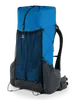
Includes hiking backpacks with a manufacturer-stated total volume of 45 to 55 litres and a catalogue weight of at most 1,000 g (2.2 lb) — every boundary is inclusive: 45 l, 55 l and exactly 1,000 g still qualify.
56 models · prices for 18 ·manually verified data· as of 10/2026
Staying under 1 kg at 50 litres means a carbon stay or a foam back panel instead of an alloy frame, a thinner hipbelt and usually a roll-top instead of a lid — the median of this class sits around 840 g, and even the heaviest models stop just short of the kilo. It works if your base weight is under 7 kg (15 lb) and the loaded pack rarely passes 12 kg (26 lb); for winter kit, snowshoes or a mandatory bear canister you want 60–70 l and a proper load-carrying frame instead.
56 models listed
Sorted: lightest first
Hiking backpacks of 45–55 litres up to 1,000 g, sortable by volume, weight and price
Every active pack from the hiking backpack category qualifies when its manufacturer-stated total volume lies between 45 and 55 litres and its catalogue weight is at most 1,000 g — 45 l, 55 l and exactly 1,000 g all count. Total volume means the figure the brand publishes for the whole pack, including external pockets and the extension collar; on weight we take the maker's standard configuration, hipbelt and lid included.
What's excluded — and why
Excluded: packs over 1,000 g — even at 1,005 g — and anything outside the 45–55 l band, so a 44 l or a 56 l model is out even though it swallows the same kit. Also excluded are models without a published volume or weight, and running vests, climbing haul bags and daypacks, which sit in their own categories. The boundaries stay hard so the list can be checked line by line.
Values as published by manufacturers · 56 included · prices for 18 · as of 10/2026
Why 45 to 55 litres
The "50" is the classic size for multi-day trips right up to a thru-hike — provided your base weight sits under roughly 7 kg (15 lb). With an 800 g tent, a quilt and a foam pad, five days of food fit into 50 litres; with traditional kit (a 2.5 kg tent, a bulky bag) it is tight before the food goes in. The band runs 45 to 55 l because brands round differently: a 45 and a 55 are the same buying decision.
One catch: the litres a maker publishes are usually total volume, including external pockets and the extension collar, not the main compartment. That is why packs badged "30" or "40" turn up here — a Durston Wapta 30 or a Hyperlite Junction 40 lands in this band once pockets and collar are counted. Read the litre column, not the model name.
Under 1 kg: frame or no frame
The lightest packs here start at 368 g, the median sits near 840 g and the ceiling is 996 g. The difference is almost always the back panel. Frameless sacks under 600 g carry comfortably to about 8–10 kg (18–22 lb); above that the load hangs off your shoulders. Packs with carbon stays or a framesheet begin at a little over 600 g and run to the kilo mark, and are typically rated for 15–18 kg (33–40 lb) with a hipbelt that actually transfers weight.
The class runs out at winter kit, snowshoes or a mandatory bear canister — then 60–70 l and a real suspension are the honest answer.