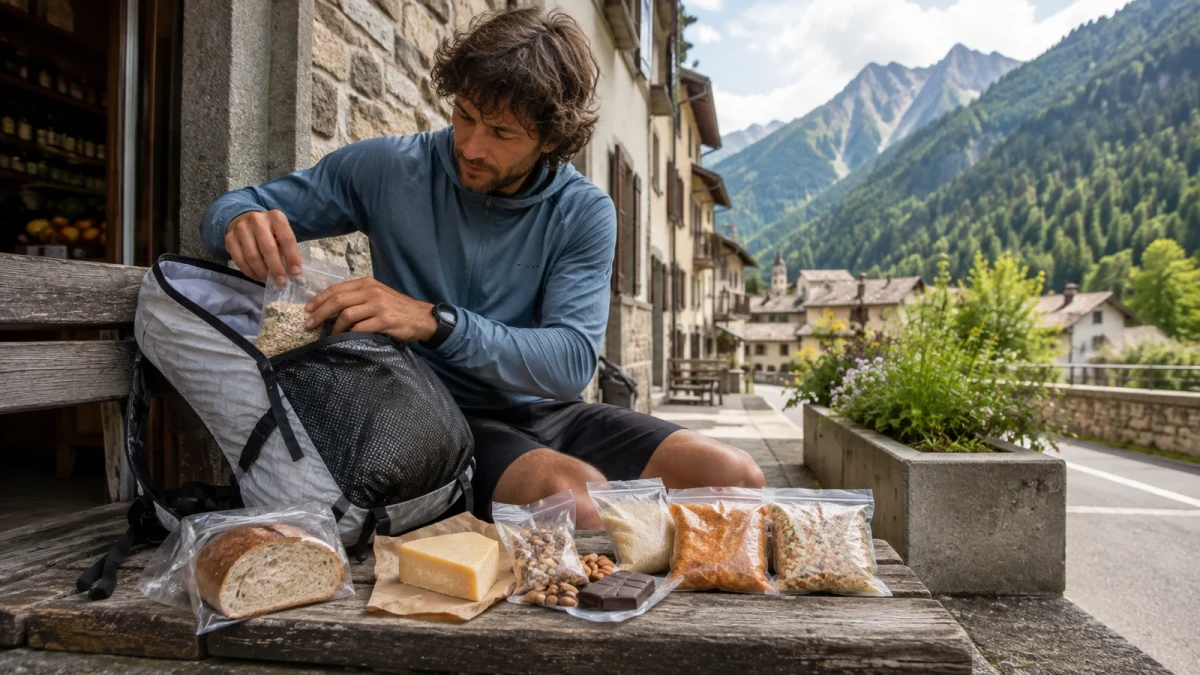
Part 30 of the HikeLab Ultimate Ultralight Guide Series.
European thru-hikers usually do best with a simple, calorie-dense food system built around 2,500 to 4,500 calories per day, frequent small resupplies, and flexibility by region. You do not need a gourmet setup, but you do need a realistic one: enough calories, enough protein, enough salt, and a resupply plan that matches how remote the route actually is.
On most long-distance hikes in Europe, the limiting factor is not finding any food. It is finding the right food at the right price, in the right amount, without carrying too much weight or wasting time in towns. The best strategy is usually to buy locally and often in populated areas, then switch to bigger carries only for mountain sections, national park stretches, or places with limited shop hours.
If you get your food strategy mostly right, hiking gets easier. If you get it wrong, everything gets harder: pace, recovery, morale, budget, and decision-making.
Key Takeaways
- Most European thru-hikers need roughly 2,500 to 4,500 calories per day, depending on body size, terrain, weather, and pace.
- Calorie density matters more than “healthy” optics when you are burning energy all day.
- In much of Europe, resupplying every 1 to 3 days is easier than carrying a full week of food.
- Mountain routes, Sundays, holidays, and shoulder-season closures can break an otherwise good plan.
- Build around cheap supermarket staples, then add restaurant meals or bakery food when available.
- Aim for a food bag that is high in carbs, moderate in fat, adequate in protein, and salty enough.
- The biggest mistakes are underestimating calories, overpacking low-calorie foods, and assuming every village shop is open.
Why Food Strategy in Europe Is Different
European hiking food planning is not the same as planning for a long US trail. In many parts of Europe, towns are closer together, public transport exists, and supermarkets are more common. That sounds easy, and often it is. But Europe adds different complications:
- Shop hours can be limited.
- Sundays can be a problem.
- Small village stores may be expensive and poorly stocked.
- Mountain huts can help, but they can also tempt you into overspending.
- Border crossings change product selection, prices, and opening habits.
- Some famous trails are heavily serviced; others are remote enough to punish bad planning.
That means your resupply strategy should not be “carry as little as possible” or “always carry a week.” It should be: carry what the next section actually requires.
How Many Calories Do European Thru-Hikers Need?
The honest answer: more than many hikers expect.
A smaller hiker on moderate terrain might be fine around 2,500 to 3,000 calories per day. A larger hiker, or anyone doing long alpine climbs with a pack, can easily need 3,500 to 4,500+ calories per day.
A practical field guide:
| Hiking Day Type | Likely Daily Calories |
|---|---|
| Easy/moderate trail, smaller hiker | 2,500-3,000 |
| Average full thru-hiking day | 3,000-3,800 |
| Big mountain day, cold weather, strong pace | 3,800-4,500+ |
If you are constantly hungry, losing weight fast, feeling cold, bonking late in the day, or waking up wrecked, you are probably under-eating.
What Changes Your Calorie Needs
- Body size and metabolism
- Daily distance and vertical gain
- Pack weight
- Temperature and wind
- How adapted you are to long days
- How often you eat during the day
In practice, many hikers start a trail eating too little because they still think like normal life eaters. Thru-hiking food is not a diet plan. It is fuel.
What Good Thru-Hiking Food Actually Looks Like
The best backpacking food is not the cleanest, prettiest, or most aspirational. It is food that is:
- Cheap enough to buy repeatedly
- Easy to find in regular supermarkets
- Calorie-dense
- Simple to carry
- Fast to prepare or edible without cooking
- Appealing enough that you will actually eat it when tired
For most hikers, the base should be:
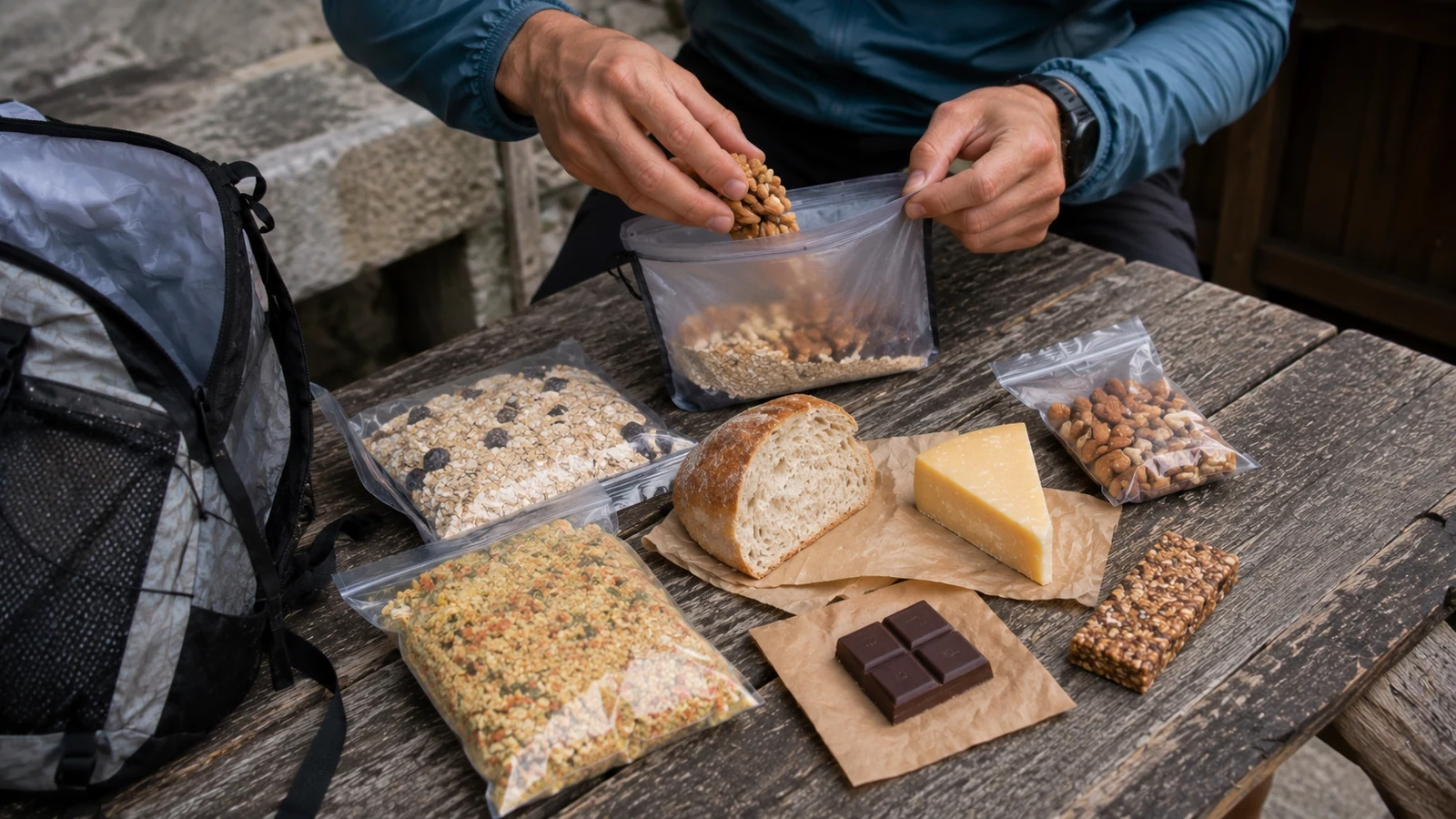
- Carbs for easy energy: bread, tortillas, oats, couscous, pasta, noodles, crackers, instant mash, muesli
- Fats for calorie density: olive oil, nuts, peanut butter, cheese, chocolate, salami
- Protein for recovery and satiety: tuna packets, cured meats, cheese, protein puddings, yogurt, milk powder, nuts, beans where practical
A Good Rule of Thumb
For trail food, try to average around 400 to 550 calories per 100 grams for most of what you carry. If your food bag is full of fruit, fresh vegetables, bulky bread, and low-fat snacks, the weight adds up fast while calories stay low.
Best Food Types for European Resupply
Europe is actually pretty good for backpacking food if you stop trying to buy idealized trail food and start buying normal local food.
Strong Core Foods
These are reliable, efficient, and commonly available:
- Oats or muesli
- Instant noodles
- Couscous
- Tortillas or wraps
- Hard cheese
- Salami or other cured sausage
- Peanut butter or hazelnut spread
- Nuts and trail mix
- Chocolate
- Biscuits and cookies
- Chips or salty crackers
- Tuna or sardine tins/packets
- Instant soup
- Energy bars or supermarket cereal bars
Foods That Work Better in Europe Than Many Hikers Expect
- Bakery sandwiches for same-day food
- Croissants and pastries for immediate calories
- Shelf-stable cheese
- Small cartons of flavored milk
- Yogurt or pudding eaten right out of town
- Olive oil added to dinner
- Dense local bread for short carries
Foods That Often Look Good but Carry Badly
- Large amounts of fresh fruit
- Raw vegetables
- Heavy glass jars
- Big tins for remote sections
- Low-calorie “health snacks”
- Fancy dehydrated meals that destroy your budget
Cook System or No-Cook?
Both work. The right answer depends on the route, season, and your tolerance for repetitive food.
No-Cook Makes Sense If:
- Resupply is frequent
- Weather is warm
- You want fast mornings and short town stops
- You are happy eating bread, cheese, sausage, snacks, and cold-soaked food
Cooking Makes Sense If:
- You are on longer mountain stretches
- Conditions are cold or wet
- You want a morale boost at camp
- You need cheaper hot calories from pasta, noodles, rice, soup, or oats
The Tradeoff
No-cook saves stove weight and simplifies logistics, but often costs more and can limit dinner quality. Cooking adds gear and fuel planning, but usually improves comfort and lets you eat cheaper high-calorie food.
For many European thru-hikers, the best answer is hybrid: cook in remote or cold sections, no-cook when town frequency makes it unnecessary.
How Often Should You Resupply?
On many European trails, every 1 to 3 days is a strong default. On more remote routes, 3 to 5 days may be normal. Longer carries happen, but they are less common than many first-time hikers fear.
Use this framework:
| Resupply Style | Best For | Main Advantage | Main Risk |
|---|---|---|---|
| 1-2 day carries | Populated routes, villages, hut networks | Light pack, flexible food choices | More town time, more temptation to underbuy |
| 3-4 day carries | Most balanced option | Efficient and safer against closures | Slightly heavier pack |
| 5+ day carries | Remote alpine or wilderness sections | Fewer resupply worries | Heavy pack, harder climbs, more planning mistakes |
The sweet spot for most hikers is buying enough for the next realistic section plus a small buffer, not stocking up “just in case” for a week every time.
How to Build a Resupply Strategy That Actually Works
A good resupply plan is not rigid. It is structured but adaptable.
1. Identify Real Remote Sections
Do not plan the whole route as if it is equally difficult to resupply. Break it into:
- Easy town-access sections
- Medium sections with small shops only
- Hard sections with closures, huts, or long gaps
This tells you where you need proper planning and where you can stay loose.
2. Check Shop Reality, Not Just Maps
A place marked “shop” does not mean:
- open daily
- open all day
- affordable
- stocked for hikers
- open in shoulder season
The classic mistake is arriving Sunday afternoon in a mountain village assuming the grocery will save you.
3. Plan Around Weekends and Holidays
This matters in Europe. A lot.
If you hit small towns on Sunday, public holidays, or off-season weekdays, expect reduced options. Carry extra food before those stretches.
4. Use Big Supermarkets When You Can
When you pass a larger town, that is when to buy the good-value staples:
- nuts
- chocolate
- wraps
- cheese
- salami
- dry carbs
- bars
Small village shops are for patching holes, not always for full efficient resupply.
5. Keep a Small Emergency Buffer
Carry one backup meal and a few emergency snacks beyond your exact plan. Not because disaster is guaranteed, but because delayed arrivals, closures, weather, and bad hunger decisions are common.
A Practical Daily Food Template
You do not need to copy this exactly, but this is the kind of structure that works.
Breakfast
- Oats or muesli
- Powdered milk or full-fat yogurt when available
- Nuts
- Chocolate or honey
Morning Snacks
- Bar
- Nuts
- Pastry or biscuits
Lunch
- Tortillas or bread
- Cheese
- Salami or tuna
- Chips or crackers
Afternoon Snacks
- Chocolate
- Trail mix
- Cookies
- Another bar
Dinner
- Couscous, noodles, pasta, or instant mash
- Soup mix or seasoning
- Cheese, sausage, tuna, or olive oil for calories
Before Bed
- Extra chocolate, nuts, or biscuit calories if you are still depleted
The bigger lesson is frequency. Many hikers do better eating small amounts all day instead of one huge lunch and a big dinner.
Budget vs Weight vs Nutrition
You usually cannot maximize all three.
Cheapest Strategy
- Buy supermarket basics
- Cook simple dinners
- Use bakeries selectively
- Avoid packaged “outdoor” meals
This wins on budget and usually performs well enough nutritionally.
Lightest Strategy
- Prioritize calorie-dense foods
- Cut bulky low-calorie items
- Minimize canned food and excess packaging
- Buy less fresh food between towns
This helps your back and your climbing pace.
Best Nutrition Strategy
- Add protein consistently
- Eat real food in towns
- Use fruit and fresh meals when you can
- Do not rely only on sugar and crackers for weeks
This is better for recovery and long-term performance, but usually not the absolute lightest or cheapest option.
The realistic answer is balance: eat efficiently on trail, then patch nutrition in town.
Common Mistakes European Thru-Hikers Make
1. Underestimating Calories
This is the biggest one. Many hikers carry “enough food” by volume but not by calories.
2. Carrying Too Much Water-Heavy Food
Fruit, fresh bread, vegetables, and ready meals can make your pack heavy fast.
3. Trusting Every Village Resupply
Small stores can be tiny, closed, or nearly empty.
4. Ignoring Sundays
This causes more bad emergency dinners than almost anything else.
5. Overspending on Hut and Convenience Food
Buying every meal at mountain huts can be pleasant, but the budget damage adds up quickly.
6. Not Eating Enough Protein or Salt
Pure sugar helps short-term energy. It does not fully cover recovery, cravings, and fatigue.
7. Buying for an Ideal Appetite
Buy for how hungry you actually get after 6 hours of climbing in bad weather, not for the neat spreadsheet version of yourself.
Decision Criteria for Your Own Strategy
Choose your food system based on these factors:
Frequent Town Access
Choose: - Short carries - More fresh food - Less complicated planning - Optional no-cook
Avoid: - Repeated overbuying - Carrying backup food for too many days
Remote Alpine Route
Choose: - Bigger carries - More calorie-dense foods - Reliable dinners - Extra emergency food
Avoid: - Heavy canned foods - Overreliance on hut opening assumptions
Tight Budget
Choose: - Supermarket staples - Basic hot meals - Bulk snacks from larger towns
Avoid: - Freeze-dried meals - Constant bakery and restaurant dependence
Sensitive Stomach or Picky Appetite
Choose: - Familiar foods - Smaller, more frequent resupplies - A tested routine before the trail
Avoid: - Building your plan around foods you only hope you will tolerate
When Mailing Boxes Makes Sense in Europe
Usually less often than on major US thru-hikes. In Europe, mail drops are often unnecessary unless:
- the route is unusually remote
- you have strict dietary restrictions
- you need specific sports nutrition
- local food options are poor in a certain country or region
- you are managing medication or complex allergies
For most hikers, local resupply is simpler than a box system. Boxes create timing problems, post office dependency, and missed pickup risk. Use them only where they solve a real problem.
FAQ
How many calories should I eat on a European thru-hike?
Most hikers land somewhere between 2,500 and 4,500 calories per day. Start by monitoring hunger, recovery, mood, pace, and weight loss. If you are fading hard by the end of the day, increase intake.
Is it better to resupply often or carry more food?
Usually resupply often where the trail allows it. Shorter carries keep pack weight down and make climbing easier. Carry more only when the next section is genuinely remote, weather is unstable, or store access is uncertain.
Do I need expensive freeze-dried backpacking meals?
No. They are convenient, but they are rarely necessary in Europe. Supermarket food is usually cheaper and good enough: couscous, noodles, instant mash, cheese, sausage, soup, chocolate, nuts, and wraps cover most needs well.
Can I thru-hike Europe with a no-cook food setup?
Yes, especially on lower, more populated routes or in warm weather. But no-cook becomes less attractive in cold, wet, or alpine conditions where hot meals improve morale and recovery.
Should I send resupply boxes ahead?
Only if you have a specific reason. Most European routes are better handled with flexible supermarket resupplies. Boxes make the most sense for dietary restrictions, niche products, or long difficult sections with poor shopping options.
Final Thoughts
The best food strategy for European thru-hikers is not complicated: eat more than you think, carry denser calories, resupply from real supermarkets when possible, and plan carefully for closures and remote stretches.
If you want one practical rule to remember, use this: buy for the next section, not for your anxiety. Carry enough to stay safe and strong, but not so much that every climb becomes harder than it needs to be. A good resupply strategy should support your hike, not dominate it.
Next Steps in the HikeLab Series
Sources
- REI Co-op
- OutdoorGearLab
- HikeLab Editors
Leave a Comment